

Overnight, the record becomes understanding.
Every night, Studio turns the last 30 days of registers into a Journey Score out of 100 for every resident, and shows who needs a closer look.
Learn, every night.
Each night, Studio reads the last 30 days of registers and works out a Journey Score out of 100 for every resident. Every night is saved, so the team can follow a resident’s journey over 7, 30 or 90 days.
Managers see who sits in Watch or Needs Support, whose mood has dipped over the past two weeks and who has gone too long without a one-to-one. Reports for homes and groups are organised by CQC key question.
What the system reads overnight.
- 01
A score out of 100, every resident, every night
Five factors, weighted towards how residents responded to their day.
- 02
Needs Attention
Whose mood has dipped over the past two weeks, and who has gone too long without a one-to-one.
- 03
The journey line
Each resident’s score over 7, 30 or 90 days, with the sessions behind every point.
- 04
Home and group reports by CQC key question
Caring, Responsive, Effective and Well-led, with the homes worth a closer look flagged first.
A resident’s journey, night by night.
IN STUDIO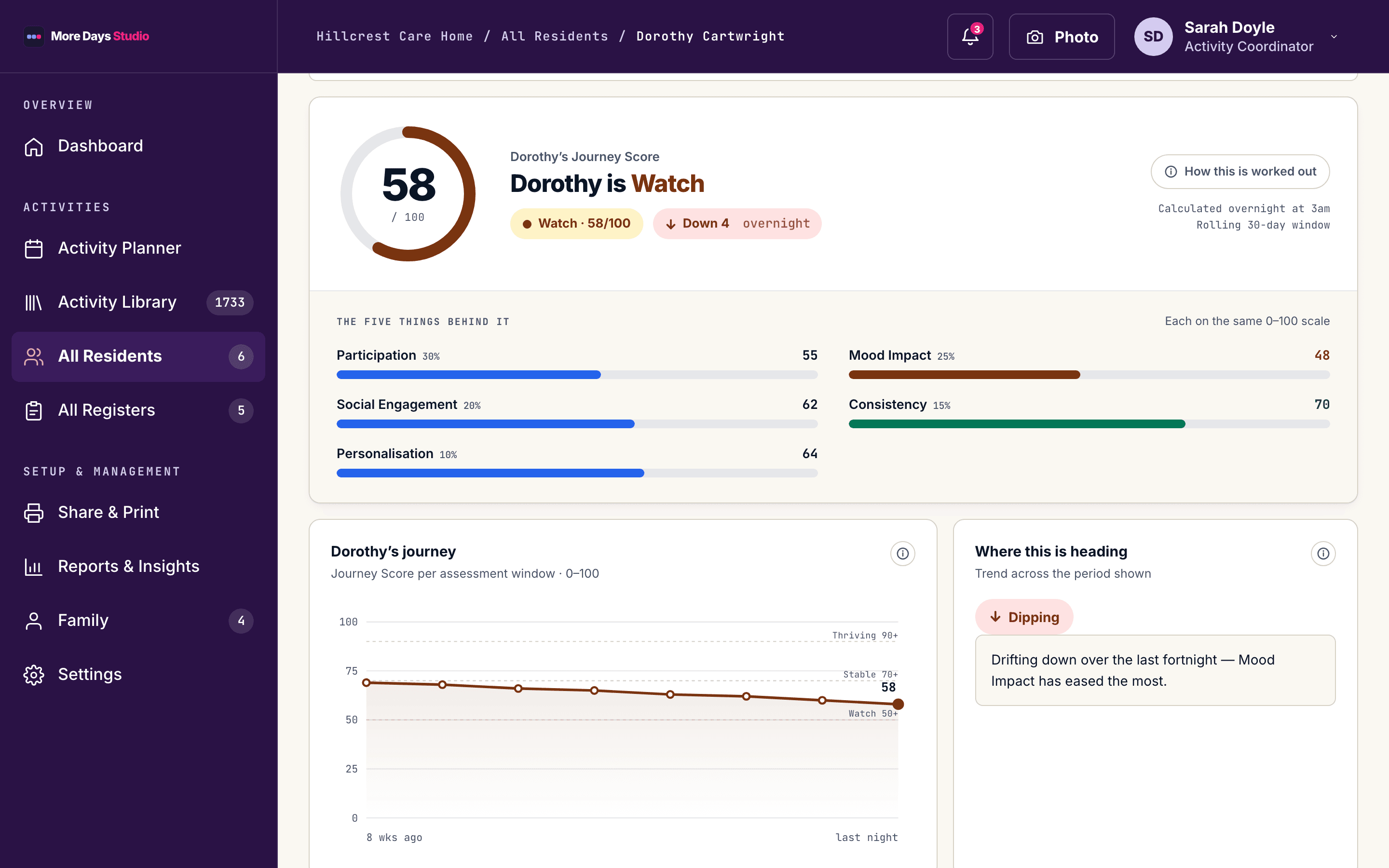
Five factors. Four bands. One number.
How the Journey Score is built: five weighted factors, combined into one score and placed in a band from Thriving to Needs Support.
- Participation30% · 4/5
- Mood impact25% · 4/5
- Social engagement20% · 3/5
- Consistency15% · 5/5
- Personalisation10% · 3/5
55% of every score is how a resident responded to their day, not whether they turned up.
What the score is
A structured reading of what care teams observe in the Living Hours. 55% comes from how residents responded to their sessions: their mood, their social engagement and how well sessions matched them. The rest is whether and how regularly they took part, so when someone stops joining in, their score falls.
What it is not
It is not a clinical assessment, and it does not replace the judgement of the people who know the resident. It reads the Living Hours, while the care record holds the care. Because it is built from staff registers, it is only as good as the registers behind it.
It’s never about putting this on autopilot. It’s a co-pilot.”
Every home counts its activities. Very few can say what they did.
Book a 30-minute walkthrough. Bring one of your homes in mind and we’ll show you what its Living Hours could show.