

Care is the start. Life is what matters.
Most care homes evidence the basics well. The Good Day Hierarchy shows what sits above them: the belonging, identity and purpose that make a life, and where the evidence is thinnest.
Person-centred care has shrunk.
Person-centred care began as a promise about the whole person: who they are, who they love and what gives their days meaning. In practice it has come to mean the basics delivered well and with choice: eating, drinking, washing, sleeping, medication and safety. Those basics matter enormously. But they are the foundation of a life, not the life itself.
“Person-centred care has become the floor. We have mistaken it for the ceiling.”
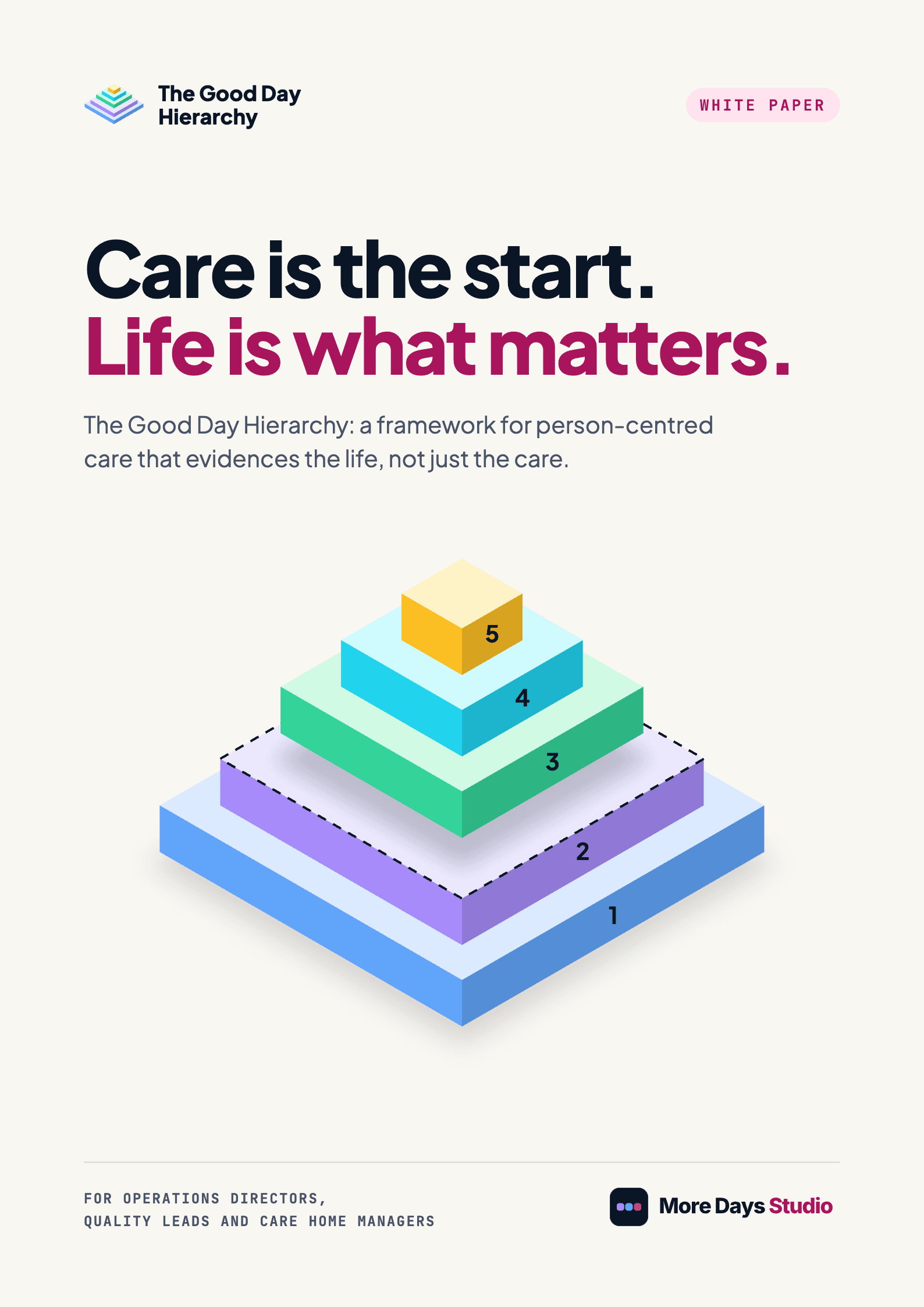
Five levels, one line between care and life.
Purpose and joy
Doing things that matter to me; using my skills; helping others; trying something new; moments of real joy; choosing how I spend my day.
Maslow: self-actualisation. Kitwood: occupation. Senses Framework: purpose and achievement.
Love and kindness run through every level. Tom Kitwood put love at the centre of every other need, so in the hierarchy it belongs everywhere rather than on one level.
- 01
It is not a ladder.
Residents don’t earn the upper levels by securing the lower ones. Someone in their final weeks still needs to be known, connected and to feel joy.
- 02
Levels 1 and 2 are the start.
They are the expected standard of any good care home, delivered with choice and dignity. Care teams deserve real credit for them.
- 03
Levels 3 to 5 are what matters.
They are what makes a life, and they are where person-centred care began.
A good day reaches every level.
- MON5 of 5
- TUE3 of 5
- WED2 of 5
- THU5 of 5
- FRI4 of 5
- SAT4 of 5
- SUN5 of 5
Wednesday was cared for, but nothing above the line.
- 5Purpose and joy
- 4Identity and significance
- 3Belonging and connection
- 2Safety and comfort
- 1Physical wellbeing
The care is recorded. The life barely shows.
Set a typical care record against the five levels and the gap is plain: plenty on safety and health, little on belonging, identity or purpose.
A timetable and an attendance list: proof that something happened, not what it meant for the person.
Care records, medication records, risk assessments and incident logs. Systems were built for them.
Five questions to ask of your own home.
- BELONGING
Who does each resident spend time with, and who is spending more time alone than a month ago?
- IDENTITY
Could a new member of staff tell you three things that make a resident feel like themselves?
- PURPOSE AND JOY
When did each resident last do something they chose, enjoyed and would want to do again?
- OWNERSHIP
Who in your organisation is accountable for whether residents’ lives are going well, not just their care?
- EVIDENCE
Could you show an inspector a resident’s last month, beyond what was on the timetable?
The Good Day Hierarchy
For Operations Directors, Quality Leads and Care Home Managers.
Download the white paper