

WHITE PAPER · OCTOBER 2026
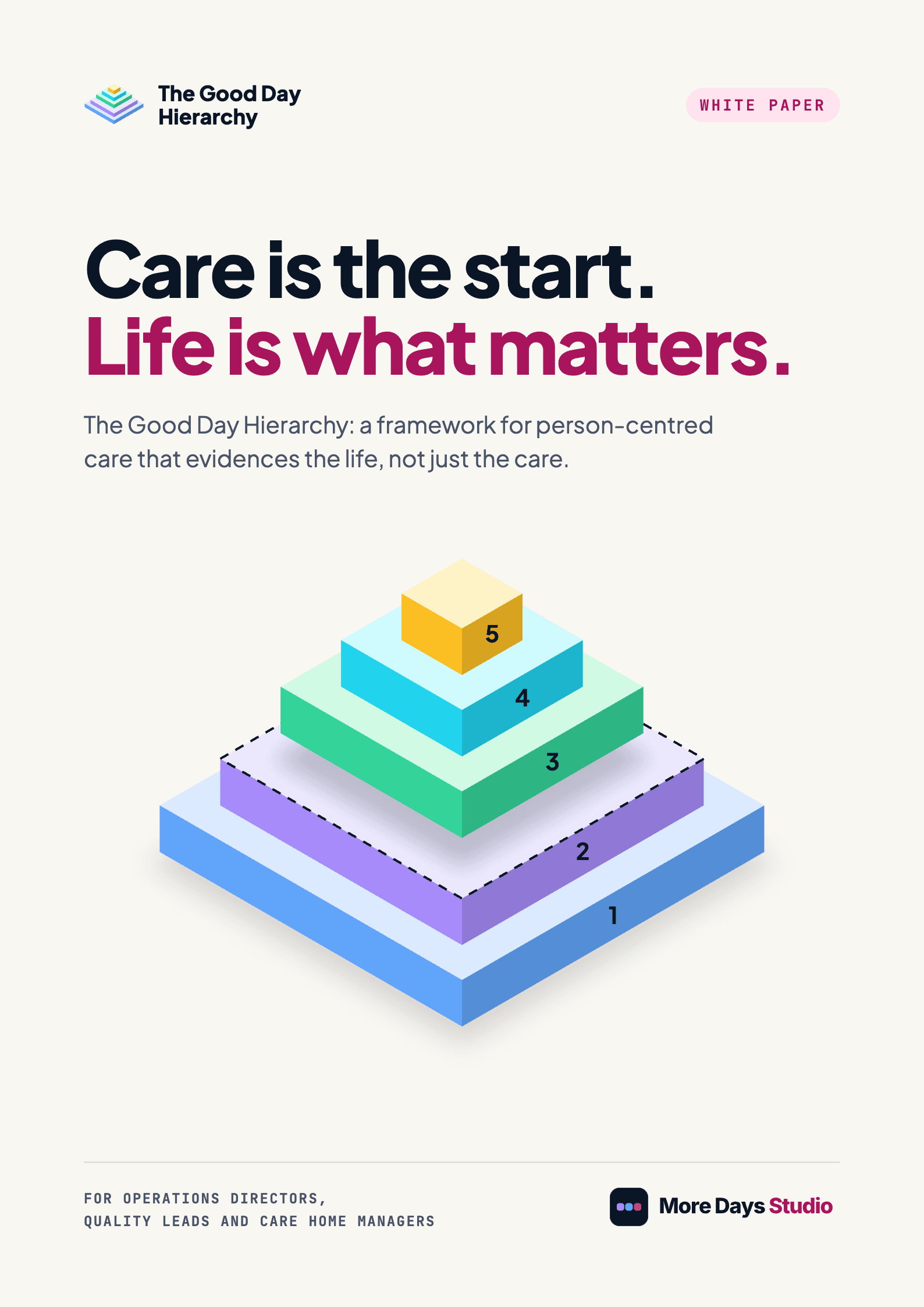
The Good Day Hierarchy
For Operations Directors, Quality Leads and Care Home Managers.
What this paper argues
- 01Person-centred care began as a statement about identity, occupation, inclusion and attachment. Its working definition has shrunk to the delivery of care tasks.
- 02The basics (physical wellbeing, safety and comfort) are the start. Belonging, identity and purpose are what make a life, and they are where evidence is thinnest.
- 03Digital care records were built to evidence the basics, so the basics are what get evidenced. That is a gap in infrastructure, not a failure of care teams.
- 04Regulation is moving towards describing what good looks like in practice. Providers who can evidence the life, not just the care, will help define that standard.
- 05The hierarchy only changes care if it is measured daily. The Journey Score is how More Days Studio turns it into a score for every resident, every night.
CONTENTS
- Executive summary
- The problem: person-centred care has shrunk
- The evidence: Kitwood, the Senses Framework and Maslow
- The Good Day Hierarchy
- The Journey Score
- Outcomes and practice, including Brampton Manor
- Putting it into practice
- References
Prefer to read the argument on the web? Read the Good Day Hierarchy, ungated →
Download the PDF
Every home counts its activities. Very few can say what they did.
Book a 30-minute walkthrough. Bring one of your homes in mind and we’ll show you what its Living Hours could show.